This maintenance sheet is suitable for all Calatheas in general and more particularly for Calatheas : Orbifolia, Makoyana, Lancifolia, Leopardina, Ornata, Triostar, Zebrina, White Fusion, Medallion, Roseopicta. Calathea is a plant which has
depolluting properties and
is not dangerous for our four-legged companions. These are these characteristics, the
beauty of its leaves and the diversity of the genus which popularized this
magnificent South American plant in our interiors.
How to maintain a Calathea ?
Humidity:
It prefers a humidity tgreater than 60%, ideally 80%. It is almost essential for its proper development, otherwise you will notice that its leaves wilt, become damaged, or turn brown in an environment that is too dry.
Exhibition:
Calathea grows at the foot of immense trees, protected from the sun by the wild canopy. It therefore prefers partial shade, tolerates darker spaces, but will hate the sun's rays.
Temperatures:
Prefer temperatures around 20°C.
Watering:
For plants of this family (Marantaceae, Calatheas and Marantas) it is necessary to keep the root ball always slightly humid, we can consider that it is necessary to water once or twice a week . In summer, it is possible to pour small quantities on the surface only every 3 days. Ideally use rainwater, distilled water or filtered water for watering and misting. To meet its high water requirements humidity you can get an air humidifier. You can use our natural fertilizer from April in September every two weeks to give it good fertilizer.
Repotting:
You can repot it in potting soil for green/indoor plants. You should repot it when its roots come out of the pot, when the new leaves are small , and/or when the old leaves at the base turn yellow and fall for no apparent reason. This is done about once a year, depending on the size of your plant in a slightly larger pot, with a hole at the bottom for drainage. It is possible to cover the bottom with clay balls for draining. We stabilize the stems well with the potting soil and water to thoroughly moisten the potting soil until the water comes out at the bottom.
Maintenance:
Clean its leaves with a soft cloth soaked in non-calcareous water and cut the dried leaves as low as possible. It can live in hydroculture! Take a beautiful vase, unpot your plant, wash its roots and watch them grow along with its leaves.
Recurring issues:
The leaves of the calatheas "open" and "close" on themselves in depending on the light, and this is normal. This can also happen depending on its water and humidity needs. If your plant is often folded in on itself, try misting it once or twice a day, moving it away from the heating and windows. You can also group it with other plants to raise the ambient humidity level or invest in a small air humidifier. If leaf tips turn brown or wilt, filter your water before watering and misting.
Decoration idea:
It's a perfect plant for bathrooms, kitchens and it will also look great in your bedroom. Its graphic leaves will bring a little different touch to refined spaces. A large Calathea in a living room will be magnificent, jungle atmosphere guaranteed.
Discover the 9 best varieties of Calathea
Because at La Green Touch we love Calatheas, we present to you our 9 best varieties to adopt and pamper without moderation!
We never tire of this pretty, intoxicating graphic foliage.
Like a true work of art, there is no need for anything else to enhance a living room.
We are a fan of its variegated foliage, particularly the pale pink stripes on the upper part which contrast with the dark green of the plant.
It is perfect for decorating and enhancing a large room to live.
We particularly admire this magnificent variegated green, cream and burgundy foliage. Illuminating and radiant, it will bring color and cheerfulness to a large, bright room!
This magnificent Calathea differs from the others with its all-green foliage, but with pretty elongated black spots, similar to that of the Maranta depressa.
For fans of rare plants, its graphic foliage is surprising, almost unrealistic, similar to a painting. Quite demanding, it needs high humidity and likes to stay in the shade.
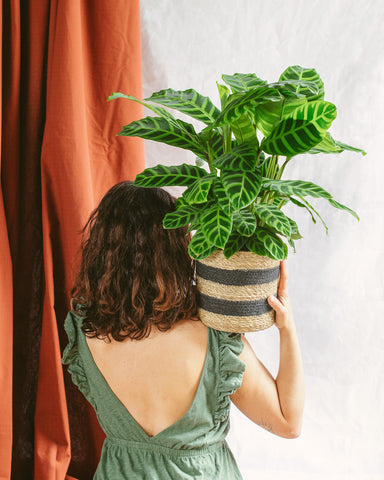
Jungle-looking plant with graphic zebra foliage.
It has dense, velvet-soft foliage. Its colors alternating between emerald green and almost fluorescent green will bring panache to your decoration
Commonly called peacock plant due to the fact that its very graphic patterns resemble those of a peacock's tail. Its contrasting leaves are pale green and dark green in color. The reverse is purple.
Also called calathea medaillon, it has beautiful leaves in multiple colors. Pink, purple, dark green... Take the time to contemplate it and admire its changing foliage!
It has depolluting properties and is not dangerous for our four-legged companions.It adapts to dark spaces, it is the ideal plant companion to bring cozy softness to any room.